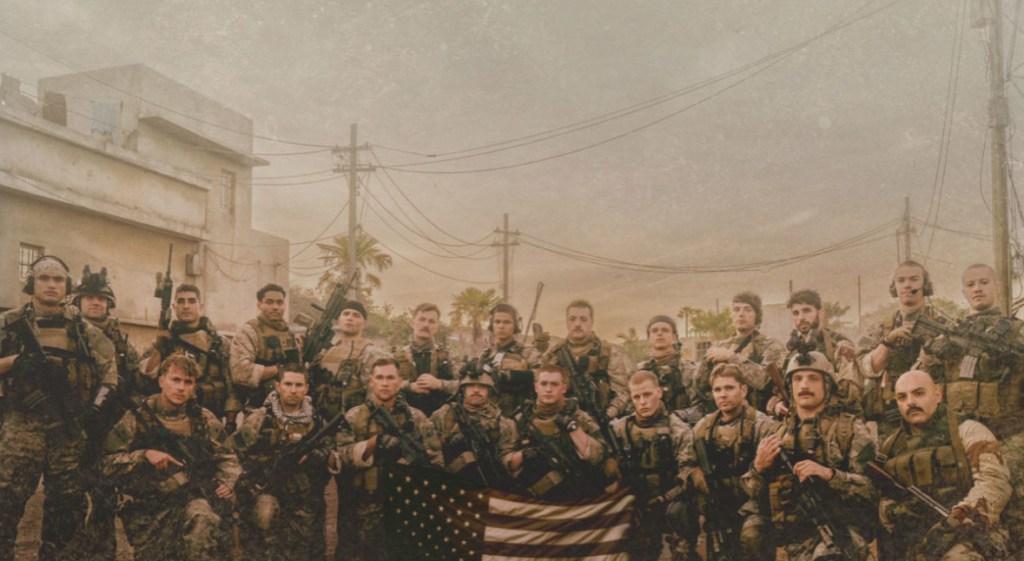
Alex Garland yet again takes on the inherently political topic of war—only to say absolutely nothing.
Garland has said he wanted to depict a realistic incident of warfare, and in that respect, he absolutely succeeds. The film captures the harshness and brutality of combat, and the immediate impact it has on the soldiers fighting—but that’s all it does. There is no characterisation, very little dialogue and almost no narrative. I don’t need a fully narrative-driven film, but I would’ve liked it to explore something more. War is so much more than just warfare.
The film is only 90 minutes long. You could easily add another hour and include something meaningful alongside the impressive, realistic depiction of warfare. Perhaps the injustice many soldiers face at the hands of the US government—something similar to All Quiet on the Western Front.
I do think it’s an interesting concept to retell this true story entirely from memory. Ray Mendoza, who is the co-writer and co-director and is portrayed by D’Pharaoh Woon-A-Tai in the film, made it as a way to remind one of the soldiers in the platoon of what happened—since he has no memory of the events himself.
Technically, the film is extraordinary. The sound design is genuinely some of the best I’ve ever heard—deafening noise comes from every direction, creating a sensory overload that fully immerses you in the chaos. It’s incredibly well-directed, and every performance is fantastic. I was particularly impressed by Kit Connor who didn’t need to say a word to convey everything that his character was going through. Joseph Quinn and Will Poulter were also very good.
I didn’t hate Warfare. It’s a very intense and engaging watch. But unfortunately, it’s not much more than that. If you’re going to see it, definitely catch it in the cinema. It’s technically fantastic—and I genuinely haven’t heard sound design like it.
Review by Jacob Wolfe
 Wolfe At The Movies
You must be logged in to post a comment.